Search Database

Henry Jackson Morton, son of St. James Church of Philadelphia rector Rev. Henry Morton, was born on December 11, 1836 in New York City. He attended the University of Pennsylvania, where he provided an impressive interpretation of the hieroglyphics of the Rosetta stone. He began studying law; however, after giving a series of well-received lectures on chemistry and physics at Philadelphia's Episcopal Academy, Mr. Morton had unwittingly chosen his new scientific career path. He became a Professor of Chemistry at the Philadelphia Dental College in 1863, and the following year he became secretary of the Franklin Institute and served as its journal editor. Mr. Morton applied his interest in art as theater to revive the Institute's tired lecture series. He engineered scientific demonstrations that were designed to be informative as well as entertaining on such topics as eclipses, fluorescence, reflection, and refraction. He paid particular attention to projection, and his experiments yielded a vertical projection lantern that he introduced to enthusiastic spectators.
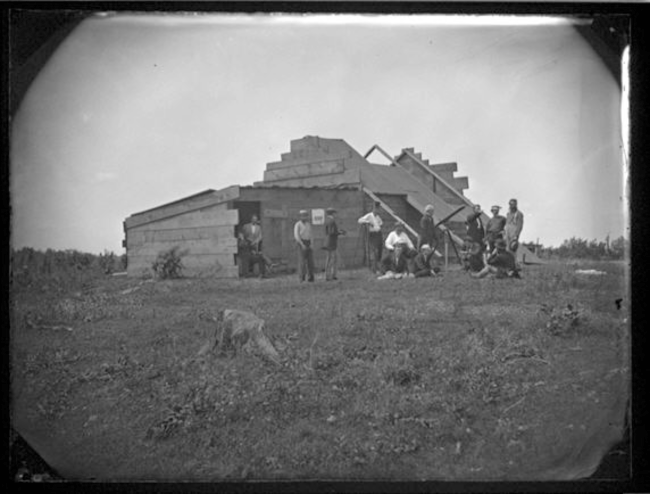
A year after joining the chemistry staff of his old alma mater, the University of Pennsylvania, Professor Morton received a Ph.D. from Dickinson College. That same year, 1869, he organized the U.S. Solar Eclipse Expedition. That August, his team of scientists and photographers assembled in Iowa, with the professor using specially constructed Alvin Clark & Sons telescope fitted with a box at its end to hold a 4-1/4x5-1/2" plate sufficient to capture two images on each plate. The shut-off slide at the front of the plate would activate the slide drop that would instantly expose a solar image onto the plate. Two telescopic cameras (for observation and direction, were invented by Professor Thomas Leighton specifically for capturing the eclipse, as was the equatorial stand that weighed nearly 500 lbs., which allowed the cameras to fully track the orbit of the sun. The large darkroom had two holes cut into one side to pass out the plates and then pass them in quickly after exposure. The telescope was positioned approximately five feet from the darkroom, which further expedited the exposure-making process. Negatives were produced at 5-to-10 minute intervals for the duration of the eclipse. While studying the photographs later, Professor Morton determined that the bright line beside the edge ot the moon was not of scientific origin, but rather "purely a photographic phenomenon."
In 1870, Professor Morton became the first president of the Stevens Institute of Technology in Hoboken, New Jersey, a position which he held until his death. His interest in photography and fluorescence continued as did his rising scientific influence, culminating in his membership into the National Academy of Sciences in 1874. During his tenure at Stevens, he funded its Department of Applied Chemistry and created a Department of Engineering Practice. His generosity became legendary, contributing in excess of $150,000 to the school. Sixty-five-year-old Professor Henry Morton died in Hoboken, New Jersey on May 9, 1902. A true Renaissance man, he was both scientist and poet, and one of Professor Morton's poems eloquently offers a fitting epitaph to the man responsible for the first photographs of a solar eclipse:
"None are alone;
Each hand in hand with each
Is traveling toward the fair sublime unknown.
Forget thy little self. One moment turn
Thine eyes upon the universe and learn
That thou, and with thee all created things,
Are fellow-architects,
Each one of whom erects
In part, from out this present heaven and earth,
New earths, new heavens of surpassing worth,
Lovely beyond thy best imaginings."
Ref:
1915 Biographical Memoir of Henry Morton 1836-1902 by Edward L. Nichols (Washington, DC: National Academy of Sciences), pp. 142-151.
2001 George Eastman House: 1869 Solar Eclipse Expedition (URL: http://www.geh.org/ar/strip34/htmlsrc/m197501300071_ful.html).
1869 The Philadelphia Photographer, Vol. VI (Philadelphia: Benerman & Wilson), pp. 19-20, 286-292.
1902 Science, Vol. XV (New York: The Macmillan Company), pp. 858-861.
# 2914
2015-05-30 09:13:11
Copyright © 2002 - 2025 Historic Camera