Search Database

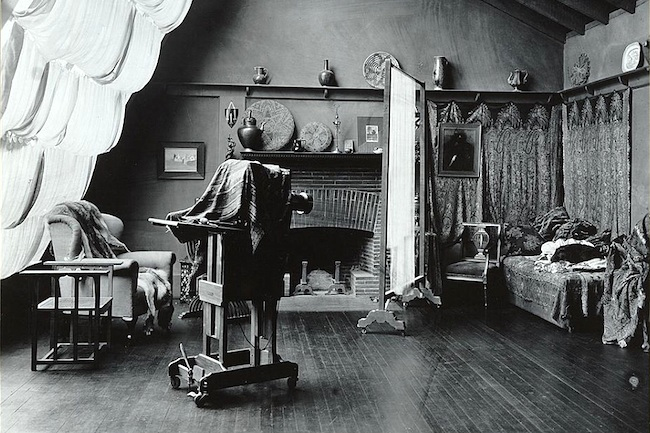
Frances Benjamin Johnston was born to Anderson and Frances Antoinette Johnston in Grafton, West Virginia on January 15, 1864. Her father served as head bookkeeper for the Treasury Department and her mother worked for the Baltimore Sun as a Washington political correspondent. From 1883-1885, she studied art at Paris's Academie Julian. Afterward, she entered the Art Students League in Washington, DC, which is where her interest in photography began. At age 21, Ms. Johnston became employed as a magazine illustrator while studying photography with Thomas William Smillie, who was director of the photography division of the Smithsonian Institution. Freelance photographic assignments followed, and included documenting the grueling work of coal miners and chronicling the educational programs of former slaves at Virginia's Hampton Institute and Alabama's Tuskegee Institute.
Ms. Johnston opened her own gallery in 1890, and her parents' political connections provided her with unprecedented access to Washington, DC's power elite. Her career accorded her a financial independence that was rare for women of the Victorian Age. Her 1896 Self-Portrait (As a "New Woman") led to increasing feminist activism, which included lobbying for the right to vote and gender equality. Obviously inheriting her mother's talents for journalism, Ms. Johnston wrote several essays on female photographers for Ladies Home Journal. In her article, "What a Woman Can Do with a Camera", which was also published in Ladies Home Journal (1897), she observed, "The woman who makes photography profitable must have, as to personal qualities, good common sense, unlimited patience to carry her through endless failures, equally unlimited tact, good taste, a quick eye, a talent for detail, and a genius for hard work. In addition, she needs training, experience, some capital, and a field to exploit." She also made the artistic distinction between a photograph and a picture, stating that it is "a true appreciation of the beautiful" that elevates the captured image. Ms. Johnston's camera of choice was a compact, lightweight 6-1/2-by-8-1/2" camera with two rapid, symmetrical lenses for indoor and outdoor photography that featured combination time and instantaneous shutters. She also recommended having more than one lighting source, and warned against the tendency to over-retouch portrait negatives.
As a member of George Grantham Bain's News Service, Ms. Johnston photographed the crew mess hall of the USS Olympia in 1899, a considerable feat for a female photographer. That same year, she covered Oval Office's War Room activities during the Spanish-American War. She also supported fledgling American female photographers and was responsible for their work being exhibited at the Paris Exposition (1900). Through her parents and her friendship with Eleanor Roosevelt, Ms. Johnston became an unofficial White House photographer during five administrations. Using a box camera she received from George Eastman, she took several pictures of President William McKinley the night before his assassination in 1901. Three years later, Ms. Johnston became a member of the Photo-Secession. She was involved in several photographic and nonprofit organizations, and served as a juror for the second Philadelphia Salon of Photography. Ms. Johnston received four grants from the Carnegie Foundation to photograph the gardens and antebellum architecture of the American South. For her efforts, the American Institute of Architects made her an honorary member in 1945. Most of her 20,000 prints and negatives were donated to the Library of Congress in 1948.
Eighty-eight year-old Frances Benjamin Johnston died in 1952. Of the woman often referred to as America's first female photojournalist, Smithsonian Magazine contributor Victoria Olsen wrote, "[Frances Benjamin] Johnston's bohemian artist still urges women forward at the same time her proper Victorian lady reminds us all to look back at what we have achieved."
Ref:
2011 American Women Artists in Wartime, 1776-2010 by Paula E. Calvin and Deborah A. Deacon (Jefferson, NC: McFarland & Company, Inc.), pp. 72-73.
2007 Encyclopedia of Nineteenth-Century Photography, Vol. I (New York: Routledge/Taylor & Francis Group LLC), p. 778.
2009 Frances Benjamin Johnston (URL: http://www.moma.org/collection/artist.php?artist_id=7851).
2011 Frances Benjamin Johnston, Three-Quarter Length Portrait, Holding and Looking Down at Camera, Facing Slightly Left (URL: http://loc.gov/pictures/resource/cph.3c20455).
2010 Victorian Womanhood, in All Its Guises by Victoria Olsen (URL: http://www.smithsonianmag.com/history/victorian-womanhood-in-all-its-guises-14265506/?no-ist).
2015 What a Woman Can Do with a Camera by Frances Benjamin Johnston (digital version of an article from Ladies Home Journal, 1897) (URL: http://www.cliohistory.org/exhibits/johnston/whatawomancando).
# 3165
2015-09-27 08:54:47
Copyright © 2002 - 2025 Historic Camera